Lincoln Hamfest: May 11, 2024
from Farren Constable, KBØAZJ, January 16, 2024
The date for the Lincoln Hamfest has just been
announced. www.lincolnhamfest.org

ARISS 40th Anniversary Event Starting
Dec. 16, 2023
from Dave Mills, KDØAZG
You may have seen that Ryan ADØTZ sent out a notice
about the ISS sending SSTV images this weekend. If you
need a SAT tracker, this is the one I use... hope it
helps. This is a link to a YouTube video
of the tracker I use, and how to use it (basic use).
Good luck.
ARISS 40th Anniversary Event Starting
Dec. 16, 2023
from Ryan Benteman, ADØTZ
The ISS is doing Slow Scan Images again. These can be
received on regular HTs, base stations, mobiles, and
especially on beams like the tape measure antennas.
Decoding can be done just by holding your cell phone
(with a SSTV app) up to the speaker.
ARISS is celebrating 40 years of human-tended
operations from space. STS-9 was the first time
amateur radio was operated by a person while in orbit,
back in late 1983. To commemorate that beginning, an
SSTV activity has been scheduled to start on December
16, about 10:15 UTC, and run until December 19, around
18:00 UTC. Operations will be on the standard 145.800
MHz downlink, using SSTV mode PD120. (announcement
link)
New Meeting Location: Manhattan/Riley County Senior
Center
from David Mills, KDØAZG, December 6, 2023
I have been working to secure a location in Manhattan
to have our meetings for the last 30 days, since
becoming the President of MAARS. I believe I have
found a location in town that meets our needs for time
frame 6 PM to 9 PM, on the second Friday of the month,
and doesn't cost MAARS anything to use. This location
also has free WIFI internet access and a camera to
broadcast our meetings, if we can figure out how to
make that happen via YouTube or Facebook. or Skype,
etc. The location is handicap accessible, with ramps
and parking paved, on one level.
The location is the Manhattan / Riley County Senior
Center, at 4th and Leavenworth St. I have set up the
first meeting for Jan. to meet at this location.
Please note your calendars.
I am NOT canceling the hall at this time at Keats.
We'll see how this goes, but it looks very promising
to me to meet our needs.
So what is the catch...
Really, there isn't any. The manager of the Senior
Center has offered to have us join the association, at
$25.00 a year. This would give us presence in the
newsletter and publication they do, that we meet
there, and also note our FB web page and our normal
web page in those publications. Individual members can
also join, if you would like. I will be presenting all
this information with more detail at the January
meeting.
The Manager of the Senior Center also advised if there
were individuals and or as a group would like to join
in or present programs, that would be well received.
As I noted, we can review and discuss at the January
meeting in more detail.
Looking forward to seeing you at the Christmas party
at Pizza Ranch Friday, Dec. 8 at 6:30 PM.
73,
Dave Mills, KDØAZG
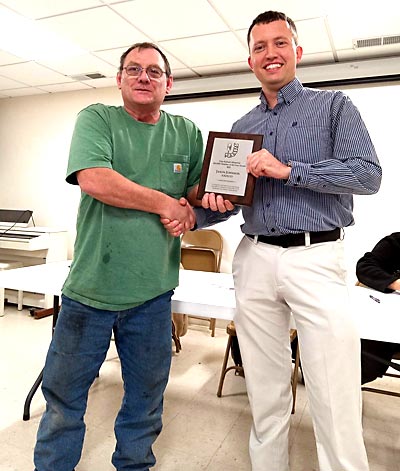
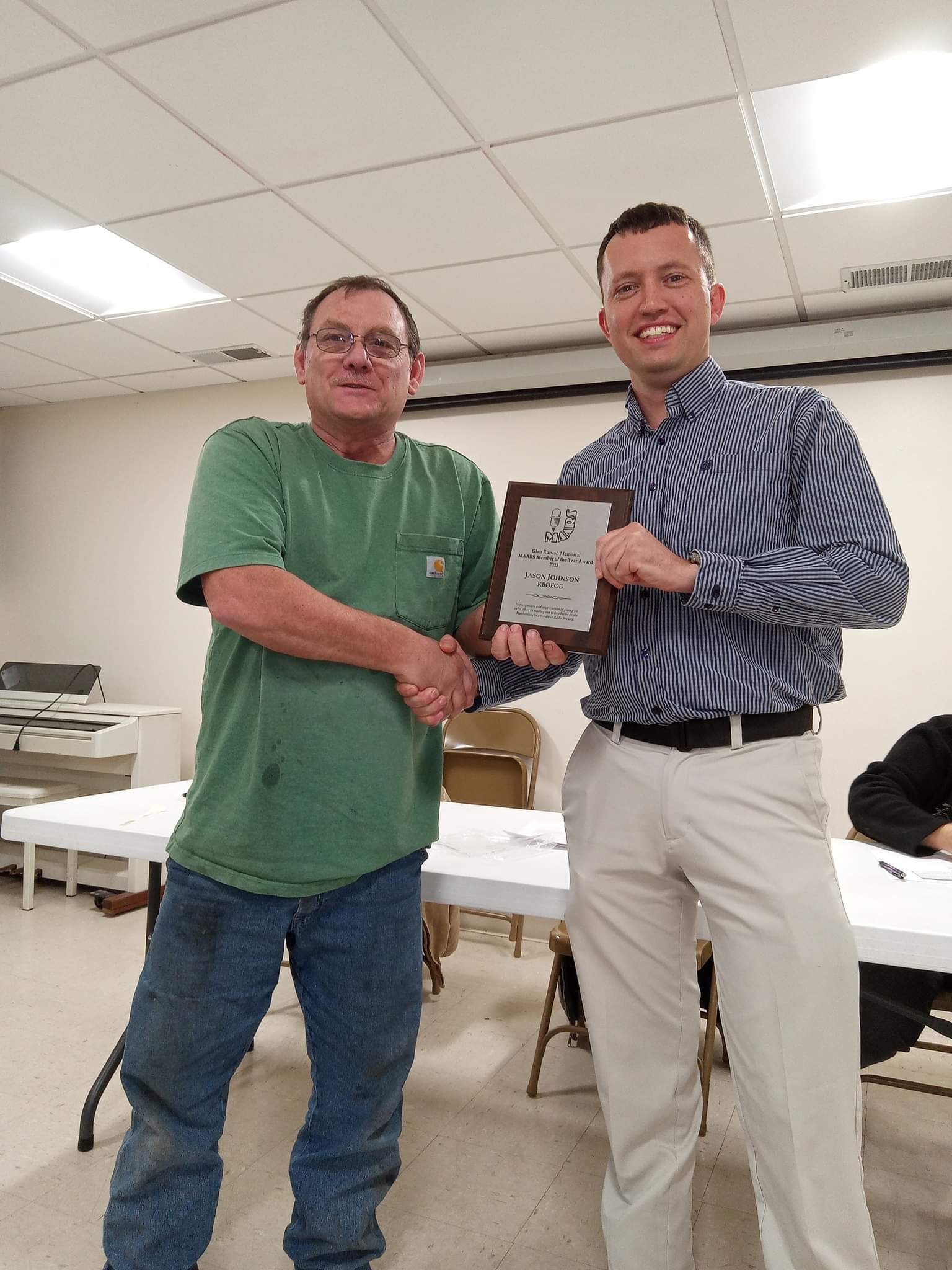
Jason Johnson, KBØEOD Receives the Glen Rubash
Award 2023
In the spring of this year, MAARS lost a valued and
appreciated member, Glen Rubash, KCØGPV. It was
decided, shortly after his passing, to establish a
Member of the Year Award in Glen's honor. Jason
Johnson, KBØEOD, whose name is seen often on this web
page, has been selected to receive the latest award.
Congratulations to him!
HSHL
from Jason Johnson, KBØEOD, October 19, 2023
There are a few of us that have HSHL in and around the
area. For those that are unfamiliar, they are VOIP
phones that are/were purchased from eBay used, and are
factory reset and flashed for use with HSHL. Anyone
with a valid amateur radio license can request a
number, plugging it into your existing internet
connection. Just another mode. You can also take it on
the road with you, and plug it into your hotel or mom
and dad's switch, and call direct PtoP, or enter into
a room similar to a Fusion/wiresX room like Kansas
City Wide or Americas Link.
It was a cool shiny object that had been untapped in
the distance. We did it, and like everything Ham,
moved on to other things, although Everyone's phones
are still operational.
Simplex Exercise (MAARS)
from Jon Klimek, KØMHK, Saturday, October 21, 2023
For those planning on the simplex exercise, if you did
not receive the link to the video conference tonight,
please send me an email, and I will send the invite
again.
Tonight (Thursday, 10/19) we will go over procedure
one more time on video chat. The Zoom link and
passcode are in the invite. Anyone who wants to
casually observe is welcome to join us at one of the
sites. Please contact me, and I can put you in touch
with the site control.
Expect about an hour of actual exercise or less. Site
control, please print off a few ICS-213 blank forms to
fill out. There is a great how-to on the shared drive
on filling out the form. If you can't download it due
to your browser security, let me know and I will email
you a copy direct.
Exercise start Saturday, October 21 at 2 p.m. /
Simplex on 146.480, with fallback to the repeater
Boy Scouts Jamboree on the Air: Questions to Ask
from K2BSA, Oct. 2023
The annual Jamboree on the Air will have thousands of
Boy Scouts on amateur radio, Oct. 20 - 22, 2023.
Here's a well-done web site that has numerous suggestions
for questions to ask.
A Duct Tape 2m Antenna!
from Farren Constable, KBØAZJ, October 13, 2023
Here's the story
by Ben Eadie, VE6SFX, which links to a YouTube
video. Thanks to Farren Constable, who recommended
this to us.
More on J-Pole Antennas
from Myron Calhoun, WØPBV, October 13, 2023
Myron contributed to the duct tape antenna topic
above, with comments and links.
"It was at least ten years ago, and I don't remember
where I read it (QST, maybe?), but I do
remember reading an article which demonstrated that
the behavior of J-Pole antennas can be greatly
affected by all sorts of things: conductor diameter
and spacing and -- especially -- proximity to other
"stuff" such as walls or glass, so if you build a
J-pole based on someone's design, to get the best
performance, be sure to test and adjust it when it is
mounted/hanging where you expect to use it, because
hanging it in "free space" vs. adjacent to a window
may cause major differences in its behavior (SWR, for
example).
Here is a link
to a large collection of antenna-related articles by
L. B. Cebik, W4RNL (SK): If you are particularly
interested in J-Poles, be sure to read his series on
"Some J-Poles That I Have Known."
Part 1: Why I Finally Got Interested in J-Poles,
and Some Cautions in Modeling Them
Part 2: The Varieties of Twinlead J-Poles, and
Some Performance Standards
Part 3: Effects of Element Diameter and
Match-Section Leg Spacing on J-Poles
Part 4: Some Things We Can and Cannot Do with a
J-Pole
Here are more Cebik-related
articles:
MAARS Mini Field Day / POTA K-7397
from Matthew Hale, KFØISO, September 23, 2023
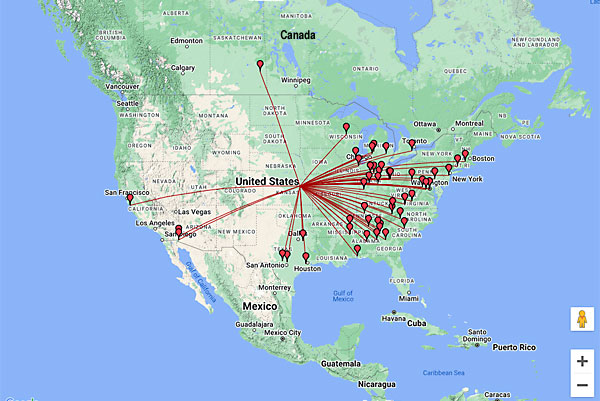
The Mini Field Day at Pottawatomie State Lake #2 was
successful. Matt Hale reports: "It was a beautiful
morning to be out at the lake... 70° with a southern
breeze. Thanks Jason, KBØEOD, and Jeff, KDØKKD for
coming out. We activated the park, and made 52
contacts on 20 M."
Field Day 2023 Report
from Dave Mills, KDØAZG, June 25, 2023
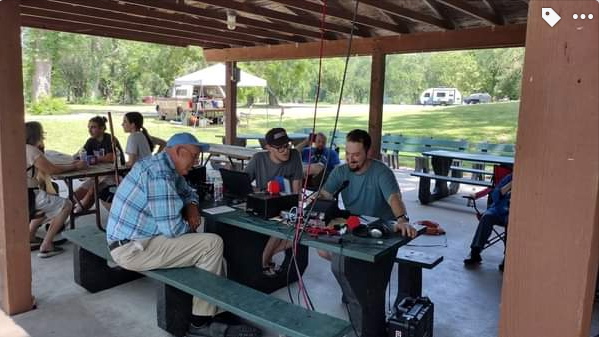
Here's a Facebook
photo gallery from ARRL Field Day 2023.
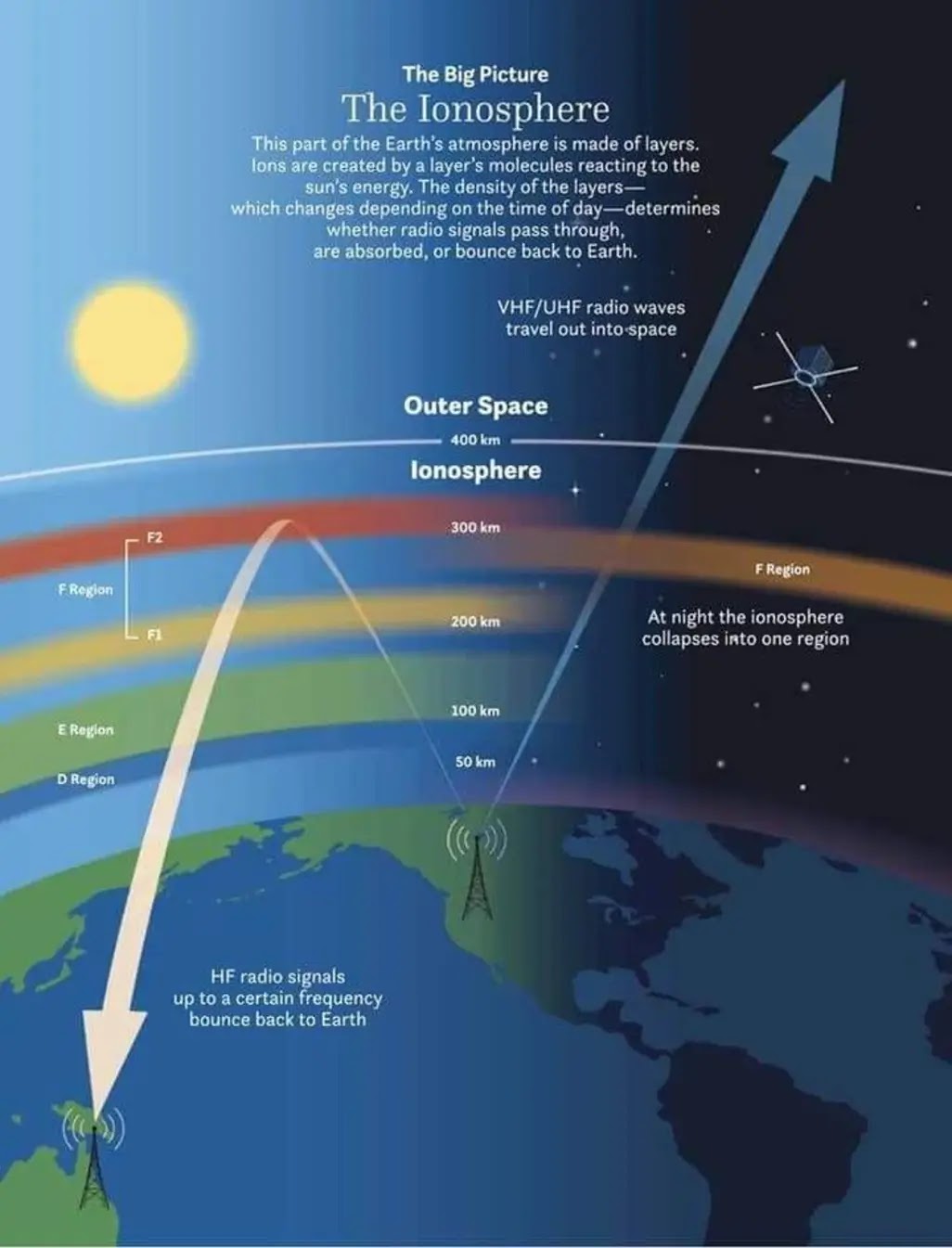
The Ionosphere
from Wally Mack, May 31, 2023
Here's a nice chart
of planet earth's ionosphere and its layers. In short,
the ionosphere varies, depending on the sun's
radiation. Amateur radio operators depend on the F
layer (primarily) to reflect HF signals from one
station to another. Signals zigzag from earth to the F
layer to other land areas or oceans, along their way
to other continents. Meanwhile, at times during the
day, the D layer absorbs lower frequency signals (such
as AM broadcast band signals) during the daytime
hours. There are lots of variables and solar phenomena
at work, such that entire books have been written
about propagation. Finally, VHF and UHF signals are
more inclined to go right through the ionosphere,
making communication with satellites, the
International Space Station, etc. possible.
Radio Antenna Fundamentals
from Myron Calhoun, WØPBV, May 24, 2023
Myron recommended Part 1 of this video, posted in
1947. YouTube
video
Glen Rubash MAARS Ham of the Year Award
from Suzanne Asbury, WØMMA, May 17, 2023
Related to this award, created in honor of the late
Glen Rubash. KCØGPV, is a document
(PDF) that outlines the considerations and
procedures for nomination for the award established by
MAARS. The document includes a brief form, and calls
for inclusion of an open-ended statement in support of
the nominee.
Glen Rubash, KCØGPV, Silent Key
by Mike Asbury, W9MPA, February 21, 2023
I am sure that by now everyone knows that Glen
suffered a massive heart attack last Monday, and
passed away Thursday night. After talking to the
family, I didn't want to post anything until the
obituary had been published.
There will be a memorial service for Glen on Saturday
the 4th of March, 9:30 - 11:30, at the Geary County
Senior Citizens Center, 1025
S. Spring Valley Road in Junction City.
There will be a small family burial the next day, on
the hill above Glen's house.
Here is the link
to his obituary. Finally, here is a PDF of the thank
you card sent to MAARS by Glen's family.
Taste of IWR - Beta Testing
by Kurt Zoglmann, ADØWE, November 2022
Some of you might be interested in beta testing the
Taste of IWR (Instant Word Recognition) Course that I
created! Feel free to download it and provide critical
feedback. You can download the course here.
The file is 863 MB. There are 106 lessons in total.
This course focuses on teaching students how to
recognize 25 words at 40 words per minute (aka Instant
Word Recognition). Don't let the speed intimidate you!
Even if you haven't mastered Morse Code or ICR
(Instant Character Recognition), you can master the
sound pattern of words. It is easier to learn the
sound pattern of code, characters or words, when they
are within a second or less. Learning handfuls of
words will accelerate your learning of Morse code as a
language.
For each word introduced, there are four practice sets
of increasing difficulty:
• Introduce New Word
• Single Word Repeated 3x
• Single Word
• Two Words
You only need to listen long enough to get a gist of
the new word in the Introduce New Word audio file.
Feel free to return to it, if you need a refresher on
that word. The Single Word Repeated 3x will play each
word randomly three times before speaking the answer.
The single word will play each word once before
speaking the answer. The Two Words audio file will
give you two random words in a row with a second of
space between them. (The new word is randomly selected
40% of the time to help you focus and learn it.)
Once you have made it through the 100 lessons and
learned the sound pattern of the 25 words, it is time
to put your IWR skills together to copy sentences!
Lessons 101 through 106 will walk you from copying at
8x Word Spacing to a standard 40 wpm! At 8x spacing,
we start with a spacing slightly larger than what you
were working with in the Two Words practice set. Then
we step down to 6x, 4x, 3x, 2x, and finally to
standard word spacing.
Advice:
If your audio player does not resume where you left
off, jump to a random spot in that audio file. You
will want to avoid inadvertently memorizing the
sequence in that file.
Make the practice active and speak your answer out
loud. Also, try and make a guess on the word, even if
you aren't sure. The attempt and instant feedback will
increase your learning efficiency.
You may find a strong tendency to want to focus on the
characters. Just relax and try and let go. (I know it
can be easier said than done.) This tendency may be
especially strong in those with a firm grasp of ICR
(Instant Character Recognition). It may be helpful to
engage in a lightly distracting activity, such as
petting your dog or cat or perhaps watching an
easy-going YouTube video with the sound off. This
problem is analogous to the challenge of learning ICR
after first learning to count dits and dahs. It may
also take several attempts over a few days to get some
initial success. Longer practice sessions are not
necessarily better.
The basis for the course:
Below are 25 common words that can be learned at 40
wpm. Why 40wpm? This is fast enough for beginners not
to recognize characters and fast enough that even the
longest word can be learned as a sound pattern. (ABOUT
takes 1.17 seconds to send at 40wpm, while WOULD takes
1.08 seconds to send.) 40wpm is also a
middle-of-the-road speed. IWR is easiest between 35 to
50wpm for most people. Beyond 50wpm and the sound
pattern tends to sound muddled because Morse code
loses its signature tone and takes on more of a
pulsating sound.
This course is designed so that students learn to
distinguish between two initial words based on their
sound patterns. Once you reach 75% correct, move to
the next lesson, which adds a new word. Each new
lesson adds an additional word, and that new word has
a 40% probability of being randomly selected. By
moving from lesson to lesson, you expand your
vocabulary of word sound patterns.
A Learning Approach to Achieve QRQ
by Kurt Zoglmann, ADØWE, March 2022
Kurt says, "I am pleased to introduce our white paper
titled A Learning Approach to Achieve QRQ. We
have developed a learning approach to achieve QRQ
using a structured high-speed curriculum! In the
paper, we propose a method to increase your CW
receiving skills from 30 to 45 wpm. It is self-paced,
and should take about a year to complete. To our
knowledge, this is the first-ever such course. You can
read it in the attached PDF, or on the Morse Code
Ninja website – A
Learning Approach to Achieve QRQ
In Morse code, speed is arbitrary, and a mutual
agreement between operators. Sending fast or slow is a
choice. Some radio enthusiasts enjoy communicating
using CW at high speeds, often defined as QRQ for
shorthand. (Formally, QRQ is a Q-signal defined as
'Send Faster.' When sent following a question mark, it
means 'shall I send faster?')
High-Speed CW is relative. What is fast to one
operator may be slow to another. One benchmark is the
CW Operators Club, which requires its members to send
and receive CW at no less than 25 wpm.
There is a form of Radio Sport known as HST
(High-Speed Telegraphy). And every two years a
bi-annual international HST competition is sponsored
by the IARU. This competition is most popular in
Eastern Europe. The competitors are divided into age
and gender groups, and they compete in both receiving
and sending CW." PDF link: A
Learning Approach to Achieve QRQ
Demystifying Morse Code
featuring Kurt Zoglmann, ADØWE, February 2022
You'll see from several posts below that Kurt Zoglmann
has put great energy into teaching and promoting Morse
Code, via his Morse Code Ninja
site, etc. He has gotten a shout out in the ARRL's On
the Air Magazine for Jan./Feb. 2022!
Actually, the League set aside the entire issue for CW
topics. Here's
a link. You'll need to click to page 20 (at top
center). Look for a bright red box.
How to Use EasyTerm and Sound Modem to Connect to
Another Station
from Dave Mills, KDØAZG, November 5, 2021
This YouTube
video is an introduction to packet radio. It was
posted to the MAARS e-mail group.
Mike Asbury, W9MPA, commented, "Thanks Dave, that was
very useful. I tried connecting direct to you but no
joy. I can connect through the KØTNT digipeater, and
can get an abbreviated Help menu and read the mail,
but can't get them to download to my mailbox in
EasyTerm.
Dave replied, "Hi, Mike. Thanks. If I'm not mistaken,
you won't be able to download the email from the
terminal to your system. You will only be able to
read, delete and forward to another station on that
same terminal, so if you have a message waiting for
you on my TNC, you can forward it to another station
on my TNC, so that they can read it on my TNC. If I'm
not mistaken, you won't be able to download the
message to your TNC directly. I could be wrong, but I
believe that's correct. One thing that EasyTerm does
have that I didn't talk about is the ability to send a
text file from my station to your station. It would
not be mail, but it would simply be a text file, and
you can set your EasyTerm up to auto receive these
files."
Reviving Packet and Other Modes
from Bill Dickinson, WSØI, May 2021
Myself and others across the states are trying to
revive packet HF/VHF and some ofÊother older analog
modes, AMTOR, Pactor 1*, and GTOR**.
All the TOR modes that use ARQ modes, must be hardware
TNCs, or require a HDLC card in your computer system.
However, all the TOR also support a 1 to many
broadcast mode called FEC, and these are supported by
soundcard/software.
So for those with soundcard/radio interfaces Signal
Link, Navigator, Microham devices, the best Packet
software modem is the UZ7HO. It is very robust, and
utilizes the Kantronics tone pair 1600/1800 center
frequency 1700, and you will need a terminal program
for TX. RMS Simple Term works very well.
The UH7HO software modem puts the AGW Packet engine to
shame both the free and Pro versions. The UZ7HO
software can be found here.
Also, there are other folks starting off the grid, no
internet linking Packet networks, which utilize kit
form KISS TNCs, that can be used on Windows, Macs,
Linux, and even Raspberry Pi's running the G8BPQ Port
Linbpq software.
The TNC board they offer will not work on HF Packet,
however. If you are interested in this area of
operation, the TARPN Network can be found here.
I am running a dedicated 24/7 40 Meter HF Packet
Network Node, running BPQ32 software with a Dual Port
TNC in KISS mode HF Port 1/VHF APRS Port 2. I am
running a BBS/Mail Server and also a Chat Room Server,
as well as APRS Igate/Digi/WX.
The Chat room is interesting, as stations that connect
to the Room can all talk to each other, or create
sub-rooms.
The LinBPQ port that runs on a raspberry PI also
supports all these features.
So, if you're tired of all the FT-xxxx Modes, dust off
your old TNCs, or hook that Soundcard interface back
up and have a real conversation again.
If you have any questions, drop me a note.
Bill, WSØI
*Pactor 1 was an open source mode created by SCS. All
other Pactor Modes 2,3,4 are proprietary to SCS, and
require license upgrade fees.
**GTOR is a proprietary mode from Kantronics.
Comm Academy
from Doug Miller, KFØDAT, April 2021
Several of the MAARS group attended an online
Emergency Comms-themed event. Thanks, John, for
setting up the Zoom meeting. For anyone who did not
have the opportunity, the YouTube videos and the
slides/presentation materials will be available at the
links below.
Comm
Academy Archives
YouTube
Morse Code Ninja Sticker
from Kurt Zoglmann, ADØWE, January 2021
If you would like a Morse Code Ninja Sticker, please
reply directly to me with your callsign (or your
address, if it is different than the one listed on
QRZ). I would be happy to send you one. The stickers
are four by two inches. They are UV resistant and
waterproof, so you can put them on your car window,
or even just a laptop/computer.
I have been sending out many stickers to celebrate
my Morse Code Ninja website – https://morsecode.ninja,
which is a great resource to learn more about Morse
code. I have a Morse Code course, 1,000s of hours of
practice to help you improve proficiency up to 50
wpm (and select content up to 100 wpm), and a
comprehensive list of related resources. (If you are
accessing the website on a phone, click the
hamburger-looking icon in the upper-right corner to
access the other pages.)
I normally ask for an SASE or a $5 donation, but I'm
happy to give back to our local amateur radio club.
:) I wish you all the best on your Morse code
journey!
Amateur Radio Bands
from Myron Calhoun, WØPBV, January 2021
Here is the latest (Jan. 2020) band chart, which is
available to anyone from the ARRL. (PDF,
1.2 MB) Other versions of the chart are
available here.
Morse Code Speed vs. Proficiency
from Kurt Zoglmann, ADØWE, December 2020
Kurt says, "I wrote this story for my Morse Code
Ninja website's Advice page — https://morsecode.ninja/advice/index.html.
I thought at least a few in the club would find it
of interest, perhaps even inspiring. Have you ever
wondered what is involved in copying Morse code at
high speed?
The unconscious mind's lightning-fast ability to
process information is the key to copying code
faster. As a general principle, as the Morse code
speed increases, a larger amount of the processing
and interpretation must be done by the unconscious
mind. And this is directly related to the four
levels of Morse code proficiency.
Levels of Morse code proficiency:
1. Conscious decoding of Dits and Dahs
2. Instant Character Recognition
3. Instant Word Recognition
4. Focus on the Meaning"
webmaster's note: Kurt's extensive comments
on CW proficiency went out to MAARS members.
He has a page on learning to copy
two and three words at a time. Finally, Kurt
has a YouTube video, Morse Code Speed
vs. Proficiency.
Lunch SSB Roundtable
from Bill Dickinson, WSØI, September 2020
We have several folks who get on 3.805 MHz almost
every day, from around 11:30 to 12:30 or so. It
started when COVID-19 hit in March, and I was
working from home. It has continued since then, even
after going back to work, as I also run 80 meter
mobile in my truck. We talk about anything and
everything: radios, weather, news, etc. We have also
been getting some of the older hybrid gear on the
back on the air. So, if you happen to find yourself
wondering what to do around this time every day,
jump on and jump in for a bit. Everyone is welcome.
Licensed Amateurs in Riley and Nearby Counties
from Myron Calhoun, WØPBV, July 2020
Myron has compiled text files of area amateurs, as
listed in the FCC database. He has lists for
Manhattan, and Clay, Geary, Marshall, Morris,
Pottawatomie and Riley counties. Click
here to access the files. Thanks to
Myron for doing this!
Emergency Checklist (If You're Called Out)
from Myron Calhoun, WØPBV, July 2020
- 3-day supply of food and water ready to go
- vehicle's gas tank at least half full
- arrangements for care of your family if called
out
- a supply of operating materials (message blanks,
pencils, logs, scratch or memo paper, etc.)
- a battery-operated transistor broadcast-band
radio, with spare batteries
- a gas-engine generator for emergency power at a
moment's notice
- portable antenna plans and materials available
- a completely portable rig that can operate
independently of your vehicle
- identification, both on your car and on your
person
- informed on assembly points or frequencies, or
other emergency plans in effect locally
|
List of Emergency Supplies
|
| siphon |
candles |
clothing |
foul-weather gear |
can & bottle openers |
| medicines |
fuses |
headphones |
3 days' food, water |
12V, 120V soldering irons |
| batteries |
toilet articles |
alarm clock |
flashlight & lantern |
sleeping bag/blankets |
| eating utensils |
tools (all kinds) |
scratch paper |
hand & laundry soap |
tow & jumper cables |
| carbon paper |
message blanks |
toilet paper |
towels & washcloths |
mirror & shaving gear |
| gas & oil |
test equipment |
battery BC radio |
pencils & erasers |
waterproof matches |
| water purifier |
maps, esp. local |
traffic log forms |
On All Bands
from Bill Dickinson, WSØI, July 2020
I am not affiliated with DX Engineering in any way,
other than being a customer. They have a pretty good
Ham Radio Blog and Information web site. It is
vendor neutral. Give it a look. (On All
Bands)
Noise and Interference Mitigation Techniques
by Bill Dickinson, WSØI, May 2020
Bill says, "I thought I would provide a bit of
online Elmering. I believe all of us are using
fairly recently designed equipment, and I thought I
would share a few tips and tricks for HF and VHF/UHF
phone operations."
- [RX] Use your IF shift and IF Width Filters to
move an interfering signal out of your receiver's
passband, and utilize your Low Cut/High Cut
filters to narrow your IF passband.
- [RX] If your equipment had DSP Noise Reduction
utilize it, and if it is adjustable, play with the
levels controls too much and you will start
hearing DSP artifacts and distortion, so you have
to vary it with conditions.
- [RX] The Noise Blanker can be a blessing and
also your worst enemy. If it is a fixed type, you
are stuck with on or off. If it is the adjustable
type, less is more, and again setting it too high
will cause AGC pumping action, distortion, and
well as generate spurs throughout your receiver.
- [RX] The AGC Control another blessing and your
worst enemy. Many are fixed with your options
being Fast, Medium, Slow, time constants or Auto.
Swap back and forth and see how your receiver acts
between Slow and Medium. Do not rely on Auto.
- [RX] RF Gain: They made this adjustable for a
reason, and everybody runs that baby cranked all
the way to the right, that's your starting point,
but did you know if you back that off, and
increase your AF gain level, you would be amazed
at the weak signals that pop up out of the noise
that were being blocked by the AGC circuit action
when it was running full bore.
- [RX] If you have a newer DSP based transceiver,
adjust your receiver bandwidth filters, 1.8K,
2.1K, 2.4K 2.6K, 2.8K, 3K and if it allows for
filter shaping, choose hard or soft shoulders as
conditions warrant. A 1.8k will not be pleasant to
listen to for very long, but it can help. Try
different widths. Some allow you to create your
own. Most transceivers default to 2.4, 2.6 or
2.8K.
- [RX] For the older rigs that utilize Crystal
filters, if your rig does not have them installed,
as many do not as these were options, look on the
swap pages. Some can be found for reasonable
prices, and 3rd party aftermarket filters which
btw are actually better than the manufacturers'
filters, are still available for many of the older
popular rigs.
- [TX] The Speech processor, and or Compressor,
utilize these as conditions warrant. Again less is
more, but what will do is increase your average
talk power, as well as boost your transmitted
audio.
- [TX] If your newer DSP rig supports adjustable
Transmit bandwidths, adjust these as needed. Many
default to 2.4K or 2.6K, with low cutoff usually
defaulting to either 200 or 300 Hz, and the High
cutoff at 2600 to 2900 Hz.
John T. Frye's Carl and Jerry (from Popular
Electronics)
from Myron Calhoun, WØPBV, May 2020
You don't have to be old to enjoy John T. Frye's Carl
and Jerry stories, published in Popular
Electronics from 1954 thru 1964 (119 stories
altogether!), but it might help! -) Visit www.copperwood.com/carlandjerry.htm
for "the rest of the story" (kudos to Paul Harvey),
and for 10 stories you can download as PDF files.
I am attaching
the first one, just to whet the appetite of all you
young whippersnappers who haven't heard of Carl and
Jerry before.
Harvard University Study on Morse Code in 1943
from Kurt Zoglmann, ADØWE, May 2020
I had the day off, and spent the afternoon restoring
a fascinating research paper on Morse Code from
Harvard University, released in the Journal of
Psychology in July 1943! (PDF
attached)
The outbreak of World Word II created a massive
demand for the United States to train men in the use
of the International Morse Code, perhaps as many as
10,000 men per month! The problem was that 30 to 60%
of men entering radiotelegraphy schools failed to
become proficient operators. The author, Donald
Taylor, carried out experiments to determine
aptitude and ways to shorten the length of time
necessary to train men to become proficient with
Morse code. The results are fascinating! And some of
it goes against commonly held beliefs in the amateur
radio community, even today!
I hope some of you will enjoy it!
All About Spectrum Scopes
from Kevin Loughin, KB9RLW, April 2020
KAØJPM here. I happened across an outstanding
27-minute YouTube video... an explanation of
spectrum scopes, waterfall displays, etc., such as
you'd see on an ICOM IC-7300. KSUARC has this radio,
and until watching this, I had very little
understanding. I don't know if I've ever seen a
better instruction video. (link)
Remotely Administered Amateur Radio Exams
The ARRL Letter, April 2020
Facing a growing demand for amateur radio exam
sessions in a time of stay-at-home orders, sponsors
of some Volunteer Examiner teams are developing
systems to remotely proctor test sessions. "Many of
our VEs and VE Teams have been working on remotely
proctored exam session ideas, employing both video
and in-person components -- following social
distancing protocols," ARRL-VEC Manager Maria Somma,
AB1FM, said. Some teams are using a combination of
Zoom and fill-and-sign Adobe PDFs. (link)
Midwest Division Newsletter
from Myron Calhoun, WØPBV, April 2020
There is some really-good HAM-related reading in the
April 2020
ARRL Midwest Division Newsletter. (previous
newsletters: www.arrlmidwest.org)
Newsletter highlights this month are:
My B-29 Flight
Ye Olde Ham Quiz
New Ham Production
After-Action Report: 2020 Missouri State-Wide
Tornado Drill
ARRL Membership Statistics Update
Midwest Division ARRL Hamfests & Conventions
State QSO Parties in the Midwest Division
Midwest Division Special Event Stations
Morse Code Ninja
from Kurt Zoglmann, ADØWE, April 2020
"My interview on the DitDit.fm podcast
was released recently: Episode
#29 – Morse Code Ninja. Feel free to check it
out! Bruce (N9WKE) was a lot of fun to talk to! It
was a joy talking to him about my love and passion
for Morse Code. We also spoke about my Morse Code Ninja
web site, and many other tips for learning Morse
code."


)window.location=%27http://ks0lnk.wavedsl.net/maps/alma440.jpg%27)